

Restoring Driver’s Licenses to Indigent Tennessee Residents
Thomas v. Haslam & Robinson v. Purkey
Between 2012 and 2017, Tennessee suspended more than a quarter of a million driver’s licenses for unpaid traffic tickets and revoked more than 140,000 licenses for unpaid court debt. The state suspended or revoked these people’s licenses without considering whether they could even afford to pay the debt. Or considering the impact suspended licenses have on Tennessee families already struggling financially, such as preventing them from going to work, seeing a doctor, taking their children to day care, or accessing other basic necessities.
In 2017, we filed two lawsuits on behalf of indigent Tennessee residents whose driver’s licenses were suspended because of these policies. The lawsuits alleged that by automatically suspending or revoking people’s licenses, the state violated the plaintiffs’ due process and equal protection rights. The cases also raised racial justice concerns: Black drivers were four times more likely to lose their licenses for nonpayment of traffic tickets than white drivers.
These lawsuits resulted in a federal court decision holding that the practice violated plaintiffs’ due process and equal protection rights. After we filed our lawsuits, the state enacted a new law providing the relief we sought in court: an indigency exception to the license suspension and revocation scheme, meaning no one would lose their license simply because they could not afford to pay a debt.
As part of this work, Civil Rights Corps cofounded Free to Drive, a nationwide campaign to end debt-based driving restrictions. A 2026 report by the Fines & Fees Justice Center found that reforms Free to Drive led or supported have resulted in $37.5 billion in financial relief for impacted people across the country.
Media & Reports
How Fines & Fees Criminalize Poverty: Explained | The Appeal | July 16, 2018
Being Poor Can Mean Losing a Driver’s License. Not Anymore in Tennessee | New York Times | July 4, 2018
Judge: Tennessee can't revoke driver's licenses from people who can't pay court costs | The Tennessean | July 3, 2018
Partners
Just City
Baker Donelson Bearman Caldwell & Berkowitz
Court Debt Filings
Thomas v. Haslam
Complaint (Jan 4, 2017)
Traffic Debt Filings
Robinson v. Purkey
Preliminary Injunction Opinion (Oct 16, 2018)
Complaint (Sep 13, 2017)
More from the Ending the Criminalization of Poverty

In re Kowalczyk. In May 2026, the California Supreme Court issued one of the most liberatory decisions in U.S. history, unanimously holding that jailing a person pretrial simply because they can’t pay money bail is unconstitutional. The California Supreme Court also held that the vast majority of people accused of crimes must be released prior to trial under the California Constitution and reaffirmed rigorous procedural protections that the government must follow if it seeks to detain a presumed innocent person.
Since the landmark Humphrey ruling, our California habeas project has expanded: providing training and partnering, so far, with 17 county public defender and appointed defender offices spanning all 6 of California’s intermediate appellate districts and the California Supreme Court.
Sandoval v. Riverside. In May 2025, individuals detained in Riverside County jails filed a class action lawsuit challenging Riverside County’s cash-based jailing of individuals between their arrest and first court hearing, as well as Riverside County’s unnecessary delay of that hearing. Rabbi David Lazar and Reverend Jane Quandt chose to join this lawsuit because they view cash-based jailing as unconscionable. The lawsuit was filed against Riverside County Superior Court, Riverside County, the Riverside County Sheriff’s Office, and Sheriff Chad Bianco.
In partnership with public defenders in Oregon, Civil Rights Corps is challenging Oregon’s longstanding practices of jailing people charged with misdemeanors prior to trial and jailing people charged with other crimes without constitutionally required due process.
Butler v. Prince George's County. In 2022, CRC and partners filed a class action lawsuit challenging Prince George’s County's pretrial detention practices. The lawsuit seeks a declaration that PG County and its officials violate Plaintiffs’ rights under the United States and Maryland Constitutions by detaining people pretrial without meeting the substantive and procedural standards required for pretrial detention.
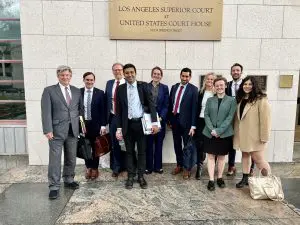
Urquidi v. City of Los Angeles. CRC and co-counsel brought suit in California Superior Court in November 2022 on behalf of several individuals who had been jailed for five days simply because they could not access enough cash to pay for their freedom.
Mays v. Dart. In 2020, when the COVID-19 pandemic hit the U.S., many of us protected ourselves by isolating in our homes. For the millions of people trapped in jails and prisons across the country, this was not an option.
Caliste v. Cantrell. In 2017, Civil Rights Corps filed a landmark federal class action lawsuit challenging the unconstitutional money bail system in New Orleans, Louisiana.
McNeil v. Community Probation Services. In 2018, five named plaintiffs sued Giles County, TN and two private probation companies on behalf of a class of people who were being supervised on for-profit probation.