



California Writ Project
Since the landmark Humphrey ruling, our California habeas project has expanded: providing training and partnering, so far, with 17 county public defender and appointed defender offices spanning all 6 of California’s intermediate appellate districts and the California Supreme Court. Our team challenges pretrial detention orders that violate Humphrey and raises novel constitutional questions aimed at expanding the right to pretrial release statewide. As of April 2026, the Habeas Project has filed over 200 habeas petitions on behalf of people detained in California in violation of Humphrey or article I, section 12 of the California Constitution. In Kowalczyk, the California Supreme Court affirmed that the legal theory we had advanced in our hundreds of habeas petitions was correct: defendants may not be detained pretrial outside the confines of section 12. In the wake of that ruling, we expect our work and impact to grow exponentially.
The project continues to push forward the cutting edge of bail law in California and nationally. In connection with our work in the courts, we are partnering with directly impacted people, community organizers, public defenders, and local officials across California to denormalize pretrial human caging and to change the assembly line culture of the bail setting.
Media coverage:
More from the Bail

In re Kowalczyk. In May 2026, the California Supreme Court issued one of the most liberatory decisions in U.S. history, unanimously holding that jailing a person pretrial simply because they can’t pay money bail is unconstitutional. The California Supreme Court also held that the vast majority of people accused of crimes must be released prior to trial under the California Constitution and reaffirmed rigorous procedural protections that the government must follow if it seeks to detain a presumed innocent person.
Sandoval v. Riverside. In May 2025, individuals detained in Riverside County jails filed a class action lawsuit challenging Riverside County’s cash-based jailing of individuals between their arrest and first court hearing, as well as Riverside County’s unnecessary delay of that hearing. Rabbi David Lazar and Reverend Jane Quandt chose to join this lawsuit because they view cash-based jailing as unconscionable. The lawsuit was filed against Riverside County Superior Court, Riverside County, the Riverside County Sheriff’s Office, and Sheriff Chad Bianco.
In partnership with public defenders in Oregon, Civil Rights Corps is challenging Oregon’s longstanding practices of jailing people charged with misdemeanors prior to trial and jailing people charged with other crimes without constitutionally required due process.
Butler v. Prince George's County. In 2022, CRC and partners filed a class action lawsuit challenging Prince George’s County's pretrial detention practices. The lawsuit seeks a declaration that PG County and its officials violate Plaintiffs’ rights under the United States and Maryland Constitutions by detaining people pretrial without meeting the substantive and procedural standards required for pretrial detention.
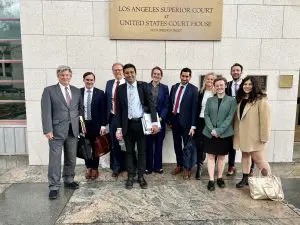
Urquidi v. City of Los Angeles. CRC and co-counsel brought suit in California Superior Court in November 2022 on behalf of several individuals who had been jailed for five days simply because they could not access enough cash to pay for their freedom.
Graff v. Aberdeen Enterprizes II, Inc. In 2017, individuals facing arrest for their inability to pay court fines sued a private collections company, the Oklahoma Sheriff’s Association, and county officials across the state, alleging that they operated an extortion scheme targeting indigent individuals who had been assessed fines in criminal and traffic court.
Mays v. Dart. In 2020, when the COVID-19 pandemic hit the U.S., many of us protected ourselves by isolating in our homes. For the millions of people trapped in jails and prisons across the country, this was not an option.
Caliste v. Cantrell. In 2017, Civil Rights Corps filed a landmark federal class action lawsuit challenging the unconstitutional money bail system in New Orleans, Louisiana.
McNeil v. Community Probation Services. In 2018, five named plaintiffs sued Giles County, TN and two private probation companies on behalf of a class of people who were being supervised on for-profit probation.