


Challenging pretrial detention practices in Oregon
In partnership with public defenders in Oregon, Civil Rights Corps is challenging Oregon’s longstanding practices of jailing people charged with misdemeanors prior to trial and jailing people charged with other crimes without constitutionally required due process.
Our clients are locked in a cage because they cannot afford the money required for their freedom. Some are charged only with misdemeanors, and so jailing them violates Oregon law, which allows jailing only for people charged with violent felonies. Others are charged with violent felonies, but have not been provided with constitutionally adequate hearings.
Unfortunately, Oregon detains thousands of people like our clients every day: people charged with misdemeanors who simply cannot afford to purchase their way out of jail, and people who are detained only because they cannot pay money without adequate due process.The project has already resulted in an important initial victory in the Oregon Supreme Court striking down certain pretrial jailing practices in Lane County, Oregon.
Filings:
Order Granting Writ (Feb 6, 2025)
Memorandum in Support of Petition (Jan 23, 2025)
Writ of Habeas Corpus Petition (Jan 23, 2025)
More from the Ending the Criminalization of Poverty

In re Kowalczyk. In May 2026, the California Supreme Court issued one of the most liberatory decisions in U.S. history, unanimously holding that jailing a person pretrial simply because they can’t pay money bail is unconstitutional. The California Supreme Court also held that the vast majority of people accused of crimes must be released prior to trial under the California Constitution and reaffirmed rigorous procedural protections that the government must follow if it seeks to detain a presumed innocent person.
Since the landmark Humphrey ruling, our California habeas project has expanded: providing training and partnering, so far, with 17 county public defender and appointed defender offices spanning all 6 of California’s intermediate appellate districts and the California Supreme Court.
Sandoval v. Riverside. In May 2025, individuals detained in Riverside County jails filed a class action lawsuit challenging Riverside County’s cash-based jailing of individuals between their arrest and first court hearing, as well as Riverside County’s unnecessary delay of that hearing. Rabbi David Lazar and Reverend Jane Quandt chose to join this lawsuit because they view cash-based jailing as unconscionable. The lawsuit was filed against Riverside County Superior Court, Riverside County, the Riverside County Sheriff’s Office, and Sheriff Chad Bianco.
Butler v. Prince George's County. In 2022, CRC and partners filed a class action lawsuit challenging Prince George’s County's pretrial detention practices. The lawsuit seeks a declaration that PG County and its officials violate Plaintiffs’ rights under the United States and Maryland Constitutions by detaining people pretrial without meeting the substantive and procedural standards required for pretrial detention.
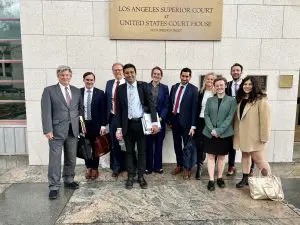
Urquidi v. City of Los Angeles. CRC and co-counsel brought suit in California Superior Court in November 2022 on behalf of several individuals who had been jailed for five days simply because they could not access enough cash to pay for their freedom.
Mays v. Dart. In 2020, when the COVID-19 pandemic hit the U.S., many of us protected ourselves by isolating in our homes. For the millions of people trapped in jails and prisons across the country, this was not an option.
Caliste v. Cantrell. In 2017, Civil Rights Corps filed a landmark federal class action lawsuit challenging the unconstitutional money bail system in New Orleans, Louisiana.
McNeil v. Community Probation Services. In 2018, five named plaintiffs sued Giles County, TN and two private probation companies on behalf of a class of people who were being supervised on for-profit probation.
Guill v. Allen. In November 2019, CRC filed a class-action lawsuit on behalf of three people locked in jail cells in Alamance County, North Carolina only because they are too poor to purchase their freedom.