


Striking Down the Money Bail System in Louisiana
Caliste et al. v. Cantrell
In 2017, Civil Rights Corps filed a landmark federal class action lawsuit challenging the unconstitutional money bail system in New Orleans, Louisiana. Each of our clients was confined in the notorious Orleans Parish Prison because he could not afford to pay a money bond after his arrest. In Louisiana, the judges who set money bonds, the prosecutors who ask for them, the sheriffs who enforce them, and the public defenders who represent the human beings who suffer from them each take a percentage cut of every money bond paid. Thousands of other people are currently going through what our named Plaintiffs went through.
In August 2018, we won summary judgment in this case. In a landmark opinion, the court essentially held that New Orleans’ money-bail system violates equal protection and due process. The court also struck down Louisiana’s statewide statutory scheme that gives judges an institutional financial conflict of interest when setting money bail.
For months following summary judgment, local courts blatantly violated the decree, routinely setting money bail amounts that people could not afford. In June 2019, the federal court issued a historic injunction that requires the elected judge in charge of money bail to follow a specific protocol when making decisions about pretrial release and detention. If the judge does not follow the protocol, they can be held in contempt of the federal court.
In August 2019, the 5th circuit court of appeals ruled unanimously that the Louisiana bail system—where judges take a percentage cut of every monetary bond they set to fund their courts—is unconstitutional.
Media Coverage:
New Orleans judges enter 'uncharted territory,' and budget peril, after federal court decisions | The Advocate | Aug 11, 2018
Appeals court ruling could bolster case against New Orleans bail system | The Advocate | Feb 18, 2018
America Is Waking Up to the Injustice of Cash Bail | The Nation | Nov 6, 2017
Federal lawsuit targets bond practices of Orleans Magistrate Judge Harry Cantrell, Jr. | nola.com | June 27, 2017
Partners:
Filings:
Injunction Order (June 13, 2019)
Summary Judgment Opinion (Aug 6, 2018)
Complaint (June 27, 2017)
More from the Bail

In re Kowalczyk. In May 2026, the California Supreme Court issued one of the most liberatory decisions in U.S. history, unanimously holding that jailing a person pretrial simply because they can’t pay money bail is unconstitutional. The California Supreme Court also held that the vast majority of people accused of crimes must be released prior to trial under the California Constitution and reaffirmed rigorous procedural protections that the government must follow if it seeks to detain a presumed innocent person.
Since the landmark Humphrey ruling, our California habeas project has expanded: providing training and partnering, so far, with 17 county public defender and appointed defender offices spanning all 6 of California’s intermediate appellate districts and the California Supreme Court.
Sandoval v. Riverside. In May 2025, individuals detained in Riverside County jails filed a class action lawsuit challenging Riverside County’s cash-based jailing of individuals between their arrest and first court hearing, as well as Riverside County’s unnecessary delay of that hearing. Rabbi David Lazar and Reverend Jane Quandt chose to join this lawsuit because they view cash-based jailing as unconscionable. The lawsuit was filed against Riverside County Superior Court, Riverside County, the Riverside County Sheriff’s Office, and Sheriff Chad Bianco.
In partnership with public defenders in Oregon, Civil Rights Corps is challenging Oregon’s longstanding practices of jailing people charged with misdemeanors prior to trial and jailing people charged with other crimes without constitutionally required due process.
Butler v. Prince George's County. In 2022, CRC and partners filed a class action lawsuit challenging Prince George’s County's pretrial detention practices. The lawsuit seeks a declaration that PG County and its officials violate Plaintiffs’ rights under the United States and Maryland Constitutions by detaining people pretrial without meeting the substantive and procedural standards required for pretrial detention.
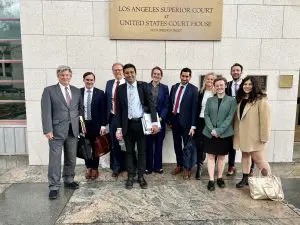
Urquidi v. City of Los Angeles. CRC and co-counsel brought suit in California Superior Court in November 2022 on behalf of several individuals who had been jailed for five days simply because they could not access enough cash to pay for their freedom.
Mays v. Dart. In 2020, when the COVID-19 pandemic hit the U.S., many of us protected ourselves by isolating in our homes. For the millions of people trapped in jails and prisons across the country, this was not an option.
McNeil v. Community Probation Services. In 2018, five named plaintiffs sued Giles County, TN and two private probation companies on behalf of a class of people who were being supervised on for-profit probation.
Guill v. Allen. In November 2019, CRC filed a class-action lawsuit on behalf of three people locked in jail cells in Alamance County, North Carolina only because they are too poor to purchase their freedom.