

Challenging the money bail system in Harris County
ODonnell et al. v. Harris County et al.
In 2016, a single mom of two girls who was arrested for driving on a suspended license sued Harris County, Texas on behalf of a class of thousands of people detained in the Harris County Jail who could not afford small sums of money for their release. After the federal court issued a preliminary injunction that was upheld on appeal, the lawsuit resulted in a landmark Consent Decree, approved in November 2019, that has transformed the misdemeanor bail system in the nation’s third largest county. As a result of this litigation, tens of thousands of people are released every year, the total number of convictions has been dramatically reduced, and the vast majority of cases end in dismissal or acquittals. Harris County has virtually eliminated the use of cash bail to detain people charged with misdemeanors. The Consent Decree is currently being monitored by a team led by Professor Brandon Garrett at Duke University and Professor Sandra Thompson-Guerra at the University of Houston.
Media Coverage:
Federal judge gives final approval to Harris County bail deal | Houston Chronicle | Dec 3, 2019
Aggressive Bail Policies Lead to Lawsuit Against Texas County | NowThis | Nov 3, 2019
Harris County reaches landmark settlement over ‘unconstitutional’ bail system | Houston Chronicle | July 26, 2019
Locked Up for Being Poor | New York Times | May 5, 2017
Judge in Houston Strikes Down Harris County's Bail System | New York Times | Apr 29, 2017
In Fight Over Bail's Fairness, A Sheriff Joins the Critics | New York Times | Mar 9, 2017
Partners:
Susman Godfrey
Texas Jail Project
Filings:
Final Approval of Settlement and Consent Decree (Nov 21, 2019)
Federal District Court Opinion (Apr 28, 2017)
Amended Complaint (Sep 1, 2016)
More from the Bail

In re Kowalczyk. In May 2026, the California Supreme Court issued one of the most liberatory decisions in U.S. history, unanimously holding that jailing a person pretrial simply because they can’t pay money bail is unconstitutional. The California Supreme Court also held that the vast majority of people accused of crimes must be released prior to trial under the California Constitution and reaffirmed rigorous procedural protections that the government must follow if it seeks to detain a presumed innocent person.
Since the landmark Humphrey ruling, our California habeas project has expanded: providing training and partnering, so far, with 17 county public defender and appointed defender offices spanning all 6 of California’s intermediate appellate districts and the California Supreme Court.
Sandoval v. Riverside. In May 2025, individuals detained in Riverside County jails filed a class action lawsuit challenging Riverside County’s cash-based jailing of individuals between their arrest and first court hearing, as well as Riverside County’s unnecessary delay of that hearing. Rabbi David Lazar and Reverend Jane Quandt chose to join this lawsuit because they view cash-based jailing as unconscionable. The lawsuit was filed against Riverside County Superior Court, Riverside County, the Riverside County Sheriff’s Office, and Sheriff Chad Bianco.
In partnership with public defenders in Oregon, Civil Rights Corps is challenging Oregon’s longstanding practices of jailing people charged with misdemeanors prior to trial and jailing people charged with other crimes without constitutionally required due process.
Butler v. Prince George's County. In 2022, CRC and partners filed a class action lawsuit challenging Prince George’s County's pretrial detention practices. The lawsuit seeks a declaration that PG County and its officials violate Plaintiffs’ rights under the United States and Maryland Constitutions by detaining people pretrial without meeting the substantive and procedural standards required for pretrial detention.
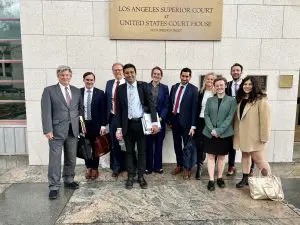
Urquidi v. City of Los Angeles. CRC and co-counsel brought suit in California Superior Court in November 2022 on behalf of several individuals who had been jailed for five days simply because they could not access enough cash to pay for their freedom.
Hester v. Gentry. In 2018, Civil Rights Corps and partners filed a lawsuit alleging that hundreds of people in Cullman County, Alabama, are routinely jailed before trial due to their inability to pay bail in exchange for their release.
Feltz v. Regalado. In 2018, Civil Rights Corps filed a lawsuit challenging Tulsa County’s unconstitutional wealth-based pretrial detention system. Tulsa County used a secured money bail schedule to determine conditions of release for almost every person arrested in the county.
Briggs v. Montgomery. In 2018, we filed a lawsuit against Maricopa County Attorney Bill Montgomery and Treatment Assessment Screening Center, Inc. for operating a diversion program that charges hundreds of dollars in fees to people accused of possessing small amounts of marijuana. In 2024, the Court approved a landmark $2.6 million settlement.