


Dismantling Debtors’ Prisons in New Orleans
Cain et al. v. City of New Orleans
In Louisiana, the judges who order and collect fines and fees from impoverished criminal defendants used to also depend on that money to fund their own budgets. In 2015, Civil Rights Corps and partners filed a lawsuit in federal court against the City of New Orleans and its local judges for jailing thousands of human beings each year just for being too poor to pay those fines and fees. The Court declared that the City’s judges violate the Constitution when they jail people for nonpayment without considering those people’s ability to pay. The Court also found that the City’s court-funding scheme creates an unconstitutional conflict of interest for its judges by encouraging them to maximize convictions and to charge as much money as possible for each one.
In August 2018, we won declaratory judgment in this case. The court found that New Orleans was unconstitutionally jailing people too poor to pay court fines, without inquiry into their ability to pay. As part of this groundbreaking decision, the federal court also essentially struck down Louisiana’s court funding system. As a result, New Orleans had to stop imposing and collecting court debts unless and until the state develops a new court funding scheme that doesn’t depend on judges collecting money from the impoverished people prosecuted in their courts.
The defendants appealed the ruling and in August 2019 the Fifth Circuit Court of Appeals affirmed the lower court’s judgment. In March 2020, the U.S. Supreme Court denied the defendants’ petition for writ of certiorari.
Additionally, in March 2020, the District Court granted the plaintiff’s request for more specific declaratory judgment that asked to court to decree it unconstitutional for any Orleans Parish Criminal District Court debtor to be imprisoned for willful nonpayment absent (1) a meaningful inquiry into the debtor’s ability to pay, preceded by notice of the importance of that issue and including an opportunity for the debtor to be heard on it, and (2) a finding that the debtor is able to pay.
Media Coverage:
New Orleans judges enter 'uncharted territory,' and budget peril, after federal court decisions | The Advocate | Aug 11, 2018
Poor New Orleans defendants land victory in 'debtors' prison' lawsuit against criminal court | The Advocate | Dec 13, 2017
Orleans judges say they have waived $1M in court fees in response to 'debtors' prison' lawsuit | The Advocate | June 25, 2017
Inside New Orleans' 'Debtors' Prison' System | City Lab | Sep 18, 2015
Suit Alleges ‘Scheme’ in Criminal Costs Borne by New Orleans’s Poor | New York Times | Sep 17, 2015
Partners:
Professor Bill Quigley
Anna Lellelid
Orrick, Herrington & Sutcliffe LLP
Filings:
Fifth Circuit Ruling Affirming District Court Decision (Aug 23, 2019)
Declaratory Judgment (Aug 3, 2018)
Summary Judgment Ruling (Dec 13, 2017)
Second Amended Complaint (Jun 29, 2016)
Statement of Facts in Support of Motion for Partial Summary Judgement (June 20, 2017)
Motion for Preliminary Injunction (Sep 22, 2015)
Amended Complaint (Sep 21, 2015)
More from the Ending the Criminalization of Poverty

In re Kowalczyk. In May 2026, the California Supreme Court issued one of the most liberatory decisions in U.S. history, unanimously holding that jailing a person pretrial simply because they can’t pay money bail is unconstitutional. The California Supreme Court also held that the vast majority of people accused of crimes must be released prior to trial under the California Constitution and reaffirmed rigorous procedural protections that the government must follow if it seeks to detain a presumed innocent person.
Since the landmark Humphrey ruling, our California habeas project has expanded: providing training and partnering, so far, with 17 county public defender and appointed defender offices spanning all 6 of California’s intermediate appellate districts and the California Supreme Court.
Sandoval v. Riverside. In May 2025, individuals detained in Riverside County jails filed a class action lawsuit challenging Riverside County’s cash-based jailing of individuals between their arrest and first court hearing, as well as Riverside County’s unnecessary delay of that hearing. Rabbi David Lazar and Reverend Jane Quandt chose to join this lawsuit because they view cash-based jailing as unconscionable. The lawsuit was filed against Riverside County Superior Court, Riverside County, the Riverside County Sheriff’s Office, and Sheriff Chad Bianco.
In partnership with public defenders in Oregon, Civil Rights Corps is challenging Oregon’s longstanding practices of jailing people charged with misdemeanors prior to trial and jailing people charged with other crimes without constitutionally required due process.
Butler v. Prince George's County. In 2022, CRC and partners filed a class action lawsuit challenging Prince George’s County's pretrial detention practices. The lawsuit seeks a declaration that PG County and its officials violate Plaintiffs’ rights under the United States and Maryland Constitutions by detaining people pretrial without meeting the substantive and procedural standards required for pretrial detention.
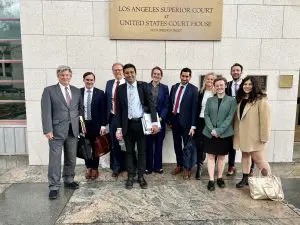
Urquidi v. City of Los Angeles. CRC and co-counsel brought suit in California Superior Court in November 2022 on behalf of several individuals who had been jailed for five days simply because they could not access enough cash to pay for their freedom.
Caliste v. Cantrell. In 2017, Civil Rights Corps filed a landmark federal class action lawsuit challenging the unconstitutional money bail system in New Orleans, Louisiana.
McNeil v. Community Probation Services. In 2018, five named plaintiffs sued Giles County, TN and two private probation companies on behalf of a class of people who were being supervised on for-profit probation.
Guill v. Allen. In November 2019, CRC filed a class-action lawsuit on behalf of three people locked in jail cells in Alamance County, North Carolina only because they are too poor to purchase their freedom.