



Challenging Money Bail Practices in Calhoun
Walker v. City of Calhoun
In 2015, Civil Rights Corps and the Southern Center for Human Rights filed a crucial lawsuit that alleged that the money bail system in Calhoun, Georgia was unconstitutional. Per the complaint, our client, Maurice Walker, was jailed for six days solely because he could not pay less than $200 after he was arrested for being a pedestrian under the influence of alcohol.
In 2020, the case was settled. Under settlement agreement:
- The City of Calhoun, GA agreed to not return to bail policies or procedures that were in effect at time of filing
- The City of Calhoun Municipal Court provided copy of standing bail order to the sheriff’s office to ensure that no arrestee under jurisdiction of the municipal court will be held in jail pursuant to a secured monetary bond solely because the arrestee cannot afford to pay the bond amount for any amount of time over 48 hours
- The City of Calhoun incorporated into a resolution a provision requiring that the new bail order be followed as a policy of the municipal court.
Our lead plaintiff, Maurice Walker, also received a monetary payment to resolve his damages claim.
Media Coverage:
This Unfair Money-Bail Scheme Gets the Challenge It Deserves | Foundation for Economic Education | Nov 22, 2017
Cash Bail, a Centerpiece of the Justice System, Is Facing Its Undoing | NBC News | Oct 3, 2016
Bail schedules are unconstitutional and bad public policy, DOJ says | ABA Journal | Aug 22, 2016
Partners:
Filings:
Complaint (Sep 8, 2015)
More from the Bail

Sandoval v. Riverside. In May 2025, individuals detained in Riverside County jails filed a class action lawsuit challenging Riverside County’s cash-based jailing of individuals between their arrest and first court hearing, as well as Riverside County’s unnecessary delay of that hearing. Rabbi David Lazar and Reverend Jane Quandt chose to join this lawsuit because they view cash-based jailing as unconscionable. The lawsuit was filed against Riverside County Superior Court, Riverside County, the Riverside County Sheriff’s Office, and Sheriff Chad Bianco.
In partnership with public defenders in Oregon, Civil Rights Corps is challenging Oregon’s longstanding practices of jailing people charged with misdemeanors prior to trial and jailing people charged with other crimes without constitutionally required due process.
Butler v. Prince George's County. In 2022, CRC and partners filed a class action lawsuit challenging Prince George’s County's pretrial detention practices. The lawsuit seeks a declaration that PG County and its officials violate Plaintiffs’ rights under the United States and Maryland Constitutions by detaining people pretrial without meeting the substantive and procedural standards required for pretrial detention.
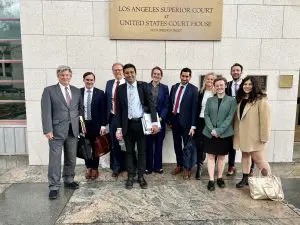
Urquidi v. City of Los Angeles. CRC and co-counsel brought suit in California Superior Court in November 2022 on behalf of several individuals who had been jailed for five days simply because they could not access enough cash to pay for their freedom.
Mays v. Dart. In 2020, when the COVID-19 pandemic hit the U.S., many of us protected ourselves by isolating in our homes. For the millions of people trapped in jails and prisons across the country, this was not an option.
Caliste v. Cantrell. In 2017, Civil Rights Corps filed a landmark federal class action lawsuit challenging the unconstitutional money bail system in New Orleans, Louisiana.
McNeil v. Community Probation Services. In 2018, five named plaintiffs sued Giles County, TN and two private probation companies on behalf of a class of people who were being supervised on for-profit probation.
Guill v. Allen. In November 2019, CRC filed a class-action lawsuit on behalf of three people locked in jail cells in Alamance County, North Carolina only because they are too poor to purchase their freedom.
Rodriguez v. Providence Community Corrections. In September 2017, Civil Rights Corps announced a landmark settlement in a first-of-its-kind class action case in federal court against Rutherford County and Providence Community Corrections, Inc., a private probation company that made millions of dollars over more than a decade by exploiting the poorest people in Rutherford County.