



Challenging the Riverside County Bail Process
Sandoval v. Riverside County et al.
In May 2025, individuals detained in Riverside County jails filed a class action lawsuit challenging Riverside County’s cash-based jailing of individuals between their arrest and first court hearing, as well as Riverside County’s unnecessary delay of that hearing. Rabbi David Lazar and Reverend Jane Quandt chose to join this lawsuit because they view cash-based jailing as unconscionable. The lawsuit was filed against Riverside County Superior Court, Riverside County, the Riverside County Sheriff’s Office, and Sheriff Chad Bianco.
The complaint alleges that every day in Riverside County, individuals—who have not been convicted of any crimes, are presumed innocent, and are not yet represented by counsel—are confined in Riverside jails, based solely on their inability to pay arbitrary, pre-set bail amounts. Individuals that cannot pay the pre-set bail amounts remain in jail until their first court hearing, which for no good reason often does not occur until four or five days after their arrest. These individuals are not detained because they have been determined to be too dangerous to release. They simply do not have the resources to pay for their freedom. California courts have repeatedly found this practice patently unconstitutional. For example, in a similar lawsuit in Los Angeles (Urquidi v. City of Los Angeles) a judge ruled that LA’s bail schedule system, which was almost identical to Riverside County’s, was unconstitutional. Yet, the complaint alleges that the Riverside County defendants continue to violate the Constitution and hold individuals in the second-deadliest jail system in the country solely because they cannot afford to pay money bail.
Cash-based bail policies like those in Riverside County are not simply unconstitutional. They also inflict severe and lasting harm on the individuals detained, their families, and their communities. Families are separated. Jailed individuals often lose their jobs and housing. Importantly, multiple scientific studies have shown that, contrary to popular belief, cash-based bail policies actually increase, rather than decrease, crime and do not increase the likelihood that individuals will appear in court for further hearings. In fact, in Urquidi, the court noted that all evidence pointed to pretrial detention being “criminogenic”: it causes more crime by destabilizing people’s lives. Many jurisdictions in California and other states have chosen to follow the law and have implemented pretrial release programs that do not depend on individuals’ ability to pay. These programs have proven to be much more effective than cash-based bail policies in improving public safety and appearance rates.
On October 1st, a judge denied two demurrers to a complaint challenging the county’s cash-based jailing of individuals between their arrest and first court hearing, as well as its unnecessary delay of that hearing. The court ruled that the arguments raised by defendants Riverside County Superior Court, County of Riverside, Riverside County Sheriff’s Office, and Sheriff Chad Bianco were without merit and that each and every one of the plaintiffs’ claims against them could proceed. The court’s opinion paves the way for a hearing to be held on the plaintiffs’ request for a preliminary injunction.
Media Coverage:
Lawsuit say county's 'cash bail' system keeps poor people in jail | The Desert Sun | May 30, 2025
Civil rights groups sue to end cash bail in Riverside County, alleging dangerous jail conditions | Los Angeles Times | May 29, 2025
Partners:
Akin Gump Strauss Hauer & Feld LLP
Hadsell Stormer Renick & Dai
Prison Law Office
Schonbrun Seplow Harris Hoffman & Zeldes, LLP
Filings:
Amended Complaint (Aug 12, 2025)
Complaint (May 28, 2025)
Application for Order to Show Cause for Preliminary Injunction (May 28, 2025)
Expert Declaration of Jennifer Copp (May 28, 2025)
More from the Bail

In partnership with public defenders in Oregon, Civil Rights Corps is challenging Oregon’s longstanding practices of jailing people charged with misdemeanors prior to trial and jailing people charged with other crimes without constitutionally required due process.
Butler v. Prince George's County. In 2022, CRC and partners filed a class action lawsuit challenging Prince George’s County's pretrial detention practices. The lawsuit seeks a declaration that PG County and its officials violate Plaintiffs’ rights under the United States and Maryland Constitutions by detaining people pretrial without meeting the substantive and procedural standards required for pretrial detention.
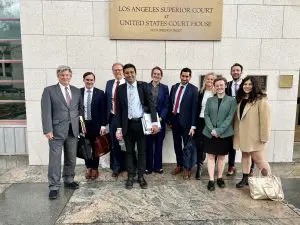
Urquidi v. City of Los Angeles. CRC and co-counsel brought suit in California Superior Court in November 2022 on behalf of several individuals who had been jailed for five days simply because they could not access enough cash to pay for their freedom.
Mays v. Dart. In 2020, when the COVID-19 pandemic hit the U.S., many of us protected ourselves by isolating in our homes. For the millions of people trapped in jails and prisons across the country, this was not an option.
Caliste v. Cantrell. In 2017, Civil Rights Corps filed a landmark federal class action lawsuit challenging the unconstitutional money bail system in New Orleans, Louisiana.
McNeil v. Community Probation Services. In 2018, five named plaintiffs sued Giles County, TN and two private probation companies on behalf of a class of people who were being supervised on for-profit probation.
Guill v. Allen. In November 2019, CRC filed a class-action lawsuit on behalf of three people locked in jail cells in Alamance County, North Carolina only because they are too poor to purchase their freedom.
Rodriguez v. Providence Community Corrections. In September 2017, Civil Rights Corps announced a landmark settlement in a first-of-its-kind class action case in federal court against Rutherford County and Providence Community Corrections, Inc., a private probation company that made millions of dollars over more than a decade by exploiting the poorest people in Rutherford County.
Walker v. City of Calhoun. In 2015, Civil Rights Corps and the Southern Center for Human Rights filed a crucial lawsuit that alleged that the money bail system in Calhoun, Georgia was unconstitutional.