

Challenging Debtors’ Prison Practices in Jennings
Jenkins et al. v. City of Jennings
In 2016, Civil Rights Corps, in partnership with ArchCity Defenders and the Saint Louis University School of Law Legal Clinics, reached a landmark settlement for impoverished people who were illegally jailed in Jennings, Missouri. The lawsuit, filed in 2015, alleged that the City of Jennings had converted its legal system into a mechanism of revenue generation in which it used its police, municipal court, and jail to extort millions of dollars every year from its most impoverished people, keeping them caught in a brutal cycle of jail and debt for years. As a result of our case, the City paid $4.75 million to nearly 2,000 impoverished people who were illegally jailed and agreed to an injunction that prevents it from ever again jailing people because they are unable to make a payment.
Media Coverage:
Missouri City to Pay $4.7 Million to Settle Suit Over Jailing Practices | New York Times | July 16, 2016
Jennings to pay $4.7M settlement to those jailed over court debts | St Louis Post-Dispatch | July 14, 2016
Debtors' Prison in 21st-Century America | The Atlantic | Feb 23, 2016
Partners:
White & Case LLP
St. Louis University School of Law Civil Litigation Clinic
Filings:
Permanent Injunction (Sep 16, 2015)
Complaint (Feb 8, 2015)
More from the Ending the Criminalization of Poverty
In re Kowalczyk. In May 2026, the California Supreme Court issued one of the most liberatory decisions in U.S. history, unanimously holding that jailing a person pretrial simply because they can’t pay money bail is unconstitutional. The California Supreme Court also held that the vast majority of people accused of crimes must be released prior to trial under the California Constitution and reaffirmed rigorous procedural protections that the government must follow if it seeks to detain a presumed innocent person.
Since the landmark Humphrey ruling, our California habeas project has expanded: providing training and partnering, so far, with 17 county public defender and appointed defender offices spanning all 6 of California’s intermediate appellate districts and the California Supreme Court.
Sandoval v. Riverside. In May 2025, individuals detained in Riverside County jails filed a class action lawsuit challenging Riverside County’s cash-based jailing of individuals between their arrest and first court hearing, as well as Riverside County’s unnecessary delay of that hearing. Rabbi David Lazar and Reverend Jane Quandt chose to join this lawsuit because they view cash-based jailing as unconscionable. The lawsuit was filed against Riverside County Superior Court, Riverside County, the Riverside County Sheriff’s Office, and Sheriff Chad Bianco.
In partnership with public defenders in Oregon, Civil Rights Corps is challenging Oregon’s longstanding practices of jailing people charged with misdemeanors prior to trial and jailing people charged with other crimes without constitutionally required due process.
Butler v. Prince George's County. In 2022, CRC and partners filed a class action lawsuit challenging Prince George’s County's pretrial detention practices. The lawsuit seeks a declaration that PG County and its officials violate Plaintiffs’ rights under the United States and Maryland Constitutions by detaining people pretrial without meeting the substantive and procedural standards required for pretrial detention.
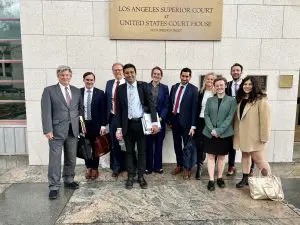
Urquidi v. City of Los Angeles. CRC and co-counsel brought suit in California Superior Court in November 2022 on behalf of several individuals who had been jailed for five days simply because they could not access enough cash to pay for their freedom.
Walker v. City of Calhoun. In 2015, Civil Rights Corps and the Southern Center for Human Rights filed a crucial lawsuit that alleged that the money bail system in Calhoun, Georgia was unconstitutional.
Edwards v. Cofield. In 2017, Civil Rights Corps and partners filed a putative class-action lawsuit alleging that the money bail system in Randolph County, Alabama, violated the constitutional rights of people charged with misdemeanors or felonies because it created a “two-tiered” system of justice based on wealth.
Robinson v. Martin. Civil Rights Corps filed a historic challenge to the unconstitutional money bail system in Cook County, Illinois. Our 2016 lawsuit alleged that the money bail system that pervaded the Chicago region, in which people are kept in jail cells solely because they cannot make monetary payments, is unconstitutional.