



Challenging Debtors’ Prison Practices in Oklahoma
Graff v. Aberdeen Enterprizes II, Inc.
On November 2, 2017, Civil Rights Corps, the Institute for Constitutional Advocacy and Protection at Georgetown Law, and private counsel filed this putative class action in the U.S. District Court for the Northern District of Oklahoma on behalf of individuals facing arrest because of their inability to pay their court fines. The plaintiffs sued Aberdeen Enterprises, a private collections company, the Oklahoma Sheriff’s Association, and every Oklahoma county sheriff. Plaintiffs seek preliminary and permanent injunctive relief, declaratory relief, compensatory and punitive damages, and attorney’s fees and costs. The plaintiffs also asked the court to certify the class as all people who were found to be indigent by the Courts of Oklahoma Counties and were victims of the alleged extortion scheme.
The lawsuit alleges that Aberdeen Enterprise, along with the Oklahoma Sheriff’s Association, operated an extortion scheme targeting indigent individuals who had been assessed fines in criminal and traffic court in Oklahoma. The plaintiffs claimed that the defendants, motivated by a desire to extort, threatened plaintiffs that if they did not pay money to Aberdeen, they would have a warrant issued, be arrested, face additional fees, and be sent to jail. According to the complaint, fines collected were split between Aberdeen and the Sheriff’s Association, and this scheme made the Sheriff’s Association $829,075 in 2016 alone. Plaintiffs claimed that the policies of keeping debtors in jail and placing them on onerous probation supervision solely because of their wealth status and inability to pay violated their constitutional rights. Additionally, plaintiffs alleged abuse of process by Aberdeen in using the justice system to accomplish ulterior motives in the form of profiting at the expense of these individuals.
The district court granted the defendant’s motions to dismiss on March 12, 2021, but, following an appeal, the Tenth Circuit overturned the district court’s ruling on April 10, 2023, remanding the case back to the district court for further proceedings. Defendants filed renewed motions to dismiss in July 2023. The district court held a hearing on the renewed motions on June 26, 2024. The parties are awaiting the Court’s decision on the renewed motions to dismiss.
Media Coverage:
Debt Company Makes Sheriffs Rich by Jailing the Poor, Lawsuit Claims | Daily Beast | Nov 9, 2017
Every sheriff in Oklahoma being sued over unpaid fees going to collection | Tulsa World | Nov 6, 2017
Partners:
Smolen Roytman
Filings:
Order Granting Motion to Dismiss (Mar 12, 2021)
Amended Complaint (Sep 21, 2018)
More from the Ending the Criminalization of Poverty

Sandoval v. Riverside. In May 2025, individuals detained in Riverside County jails filed a class action lawsuit challenging Riverside County’s cash-based jailing of individuals between their arrest and first court hearing, as well as Riverside County’s unnecessary delay of that hearing. Rabbi David Lazar and Reverend Jane Quandt chose to join this lawsuit because they view cash-based jailing as unconscionable. The lawsuit was filed against Riverside County Superior Court, Riverside County, the Riverside County Sheriff’s Office, and Sheriff Chad Bianco.
In partnership with public defenders in Oregon, Civil Rights Corps is challenging Oregon’s longstanding practices of jailing people charged with misdemeanors prior to trial and jailing people charged with other crimes without constitutionally required due process.
Butler v. Prince George's County. In 2022, CRC and partners filed a class action lawsuit challenging Prince George’s County's pretrial detention practices. The lawsuit seeks a declaration that PG County and its officials violate Plaintiffs’ rights under the United States and Maryland Constitutions by detaining people pretrial without meeting the substantive and procedural standards required for pretrial detention.
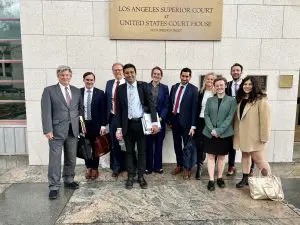
Urquidi v. City of Los Angeles. CRC and co-counsel brought suit in California Superior Court in November 2022 on behalf of several individuals who had been jailed for five days simply because they could not access enough cash to pay for their freedom.
Rodriguez v. Providence Community Corrections. In September 2017, Civil Rights Corps announced a landmark settlement in a first-of-its-kind class action case in federal court against Rutherford County and Providence Community Corrections, Inc., a private probation company that made millions of dollars over more than a decade by exploiting the poorest people in Rutherford County.
Walker v. City of Calhoun. In 2015, Civil Rights Corps and the Southern Center for Human Rights filed a crucial lawsuit that alleged that the money bail system in Calhoun, Georgia was unconstitutional.
Edwards v. Cofield. In 2017, Civil Rights Corps and partners filed a putative class-action lawsuit alleging that the money bail system in Randolph County, Alabama, violated the constitutional rights of people charged with misdemeanors or felonies because it created a “two-tiered” system of justice based on wealth.
Robinson v. Martin. Civil Rights Corps filed a historic challenge to the unconstitutional money bail system in Cook County, Illinois. Our 2016 lawsuit alleged that the money bail system that pervaded the Chicago region, in which people are kept in jail cells solely because they cannot make monetary payments, is unconstitutional.

Fant v. City of Ferguson. In 2015, we filed a landmark challenge to the City of Ferguson’s conversion of its legal system into a mechanism for generating revenue. The lawsuit sought justice for thousands of people who alleged that Ferguson routinely violated their constitutional rights by jailing them in deplorable conditions and without the necessary legal process because they could not pay money to the City.