




Challenging the Money Bail System in Tulsa County
Feltz v. Regalado et al.
(formerly Feltz v. Board of County Commissioners of Tulsa County et al. and Parga v. Tulsa County et al.)
On June 6, 2018, Civil Rights Corps filed a lawsuit challenging Tulsa County’s unconstitutional wealth-based pretrial detention system. Tulsa County used a secured money bail schedule to determine conditions of release for almost every person arrested in the county. The process was as straightforward as it was unjust: upon arrest, a person was given a money bail amount that corresponds to the charges they are booked on; if they could pay the amount, they were released. If they couldn’t pay the amount, they were jailed. There was no inquiry into or consideration of the person’s ability to pay the money-bail amount. So, if they couldn’t pay, they were jailed for at least a week, before they were able to see a judge.
The results were devastating. Previously, on an average day, more than 62% of people incarcerated in the Tulsa County Jail — over 1,500 people — were awaiting trial. They had not been convicted of a crime and therefore were presumptively innocent. Additionally, Tulsa County’s pretrial detention rate was 83% higher than the national average.
In 2024, we won an important ruling in federal court, and the Court and the parties are now negotiating a remedy to fix the constitutional violations.
We are litigating this case alongside Still She Rises, a Tulsa-based holistic defense project that represents mothers.
Partners:
Filings:
Second Amended Complaint (March 3, 2021)
Complaint (June 6, 2018)
More from the Bail

Sandoval v. Riverside. In May 2025, individuals detained in Riverside County jails filed a class action lawsuit challenging Riverside County’s cash-based jailing of individuals between their arrest and first court hearing, as well as Riverside County’s unnecessary delay of that hearing. Rabbi David Lazar and Reverend Jane Quandt chose to join this lawsuit because they view cash-based jailing as unconscionable. The lawsuit was filed against Riverside County Superior Court, Riverside County, the Riverside County Sheriff’s Office, and Sheriff Chad Bianco.
In partnership with public defenders in Oregon, Civil Rights Corps is challenging Oregon’s longstanding practices of jailing people charged with misdemeanors prior to trial and jailing people charged with other crimes without constitutionally required due process.
Butler v. Prince George's County. In 2022, CRC and partners filed a class action lawsuit challenging Prince George’s County's pretrial detention practices. The lawsuit seeks a declaration that PG County and its officials violate Plaintiffs’ rights under the United States and Maryland Constitutions by detaining people pretrial without meeting the substantive and procedural standards required for pretrial detention.
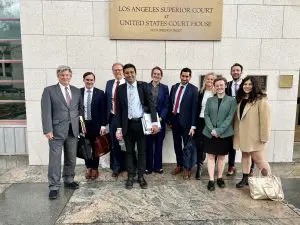
Urquidi v. City of Los Angeles. CRC and co-counsel brought suit in California Superior Court in November 2022 on behalf of several individuals who had been jailed for five days simply because they could not access enough cash to pay for their freedom.
Mays v. Dart. In 2020, when the COVID-19 pandemic hit the U.S., many of us protected ourselves by isolating in our homes. For the millions of people trapped in jails and prisons across the country, this was not an option.
Caliste v. Cantrell. In 2017, Civil Rights Corps filed a landmark federal class action lawsuit challenging the unconstitutional money bail system in New Orleans, Louisiana.
McNeil v. Community Probation Services. In 2018, five named plaintiffs sued Giles County, TN and two private probation companies on behalf of a class of people who were being supervised on for-profit probation.
Guill v. Allen. In November 2019, CRC filed a class-action lawsuit on behalf of three people locked in jail cells in Alamance County, North Carolina only because they are too poor to purchase their freedom.
Rodriguez v. Providence Community Corrections. In September 2017, Civil Rights Corps announced a landmark settlement in a first-of-its-kind class action case in federal court against Rutherford County and Providence Community Corrections, Inc., a private probation company that made millions of dollars over more than a decade by exploiting the poorest people in Rutherford County.